
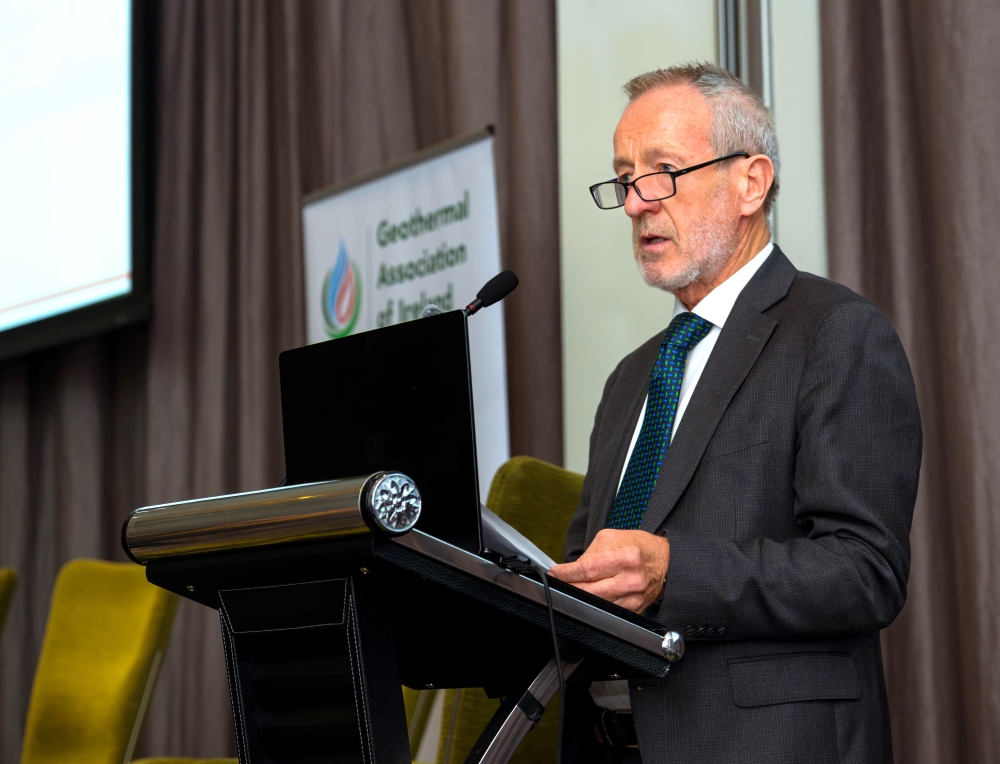
Seán Kelly MEP was a keynote speaker at the European Geothermal District Heating & Cooling Conference, which was held at The Gibson Hotel in Dublin (Ireland) on 3 September 2026. The Conference was co-organised by EGEC and GAI (Geothermal Association of Ireland). Mr Kelly has served as a Member of the European Parliament since 2009 (elected in the South of Ireland). He is a full member of the European Parliament’s Committee on Industry, Research and Energy. He also leads the Irish delegation within the EPP Group, which is the largest political group in the European Parliament.
Photo: Cristina Pulidori (@cris35mm_) for EGEC & GAI, 2026
Here is the prepared text of Mr Kelly’s speech (published with his permission):
Ladies and gentlemen, it is a pleasure to join you here in Dublin for the Geothermal District Heating and Cooling Days.
I want to begin by welcoming the European geothermal community to Ireland and congratulating the European Geothermal Energy Council and the Geothermal Association of Ireland for bringing this event here.
Today’s discussion is timely, simply because we have a major heating challenge in Ireland.
We have significant geothermal potential, and we have a developing district heating sector. Perhaps most importantly, however, is that we have an increasingly urgent need to reduce our dependence on imported fossil fuels.
For many years, Europe built a large part of its economy around an assumption that imported fossil fuels would remain relatively cheap, stable and readily available.
Russia’s invasion of Ukraine exposed just how big a mistake that was, and the instability we have seen in the Middle East this year has done so again.
We learned after Russia’s invasion that Europe could change from where it bought its fossil fuels. However, the crisis in the Strait of Hormuz over the past six months has reminded us that diversifying suppliers is not the same thing as achieving energy independence.
As long as we remain dependent on imported fossil fuels, events thousands of kilometres from Ireland can still determine what an Irish household or business pays for energy.
That vulnerability has consequences for households through their energy bills, for businesses through higher operating costs, and ultimately for our competitiveness as a country and as a European Union.
A business making an investment needs some confidence about what its energy costs will look like in five, ten or fifteen years, and at the moment, both in Ireland and across Europe, we are struggling to give them this confidence.
We remain heavily dependent on imported fossil fuels for heat, while natural gas continues to play a major role in our electricity system.
More than 90 per cent of Irish heat demand was still being met by fossil fuels in 2024, with renewables accounting for only 7.9 per cent of heat consumption. We are very exposed and vulnerable.
I believe delivering energy independence must become the central objective of European energy policy, and for Ireland that means using far more of the energy resources available to us here at home.
On the 17th of July, the European Commission published its new Electrification Action Plan, and I believe this will be one of the most consequential pieces of European energy policy in this Commission’s mandate.
The starting point for this strategy is eye-opening: Around 70 per cent of European electricity is now generated from clean energy sources. Yet electricity still accounts for only around 23 per cent of final energy demand, and that figure has barely moved over the past decade.
The Commission therefore wants Europe to become what it describes as the world’s first electro-powered continent. It will assess an electrification target of 46 per cent by 2040.
The Commission estimates that reaching that level could reduce Europe’s fossil fuel import bill by €260 billion every year.
That is €260 billion leaving the European economy every year to pay for imported fossil fuels rather than being invested in European infrastructure, European industry and European jobs. That’s the cost of well over 100 National Children’s Hospitals leaving the EU every year.
There is a clear realisation at EU level now that electrification is a critical part of our energy, industrial, competitiveness and Climate policies, and Geothermal Energy has a very clear place within that agenda.
That is one of the things I particularly welcome about the new Action Plan.
The Commission explicitly identifies geothermal as an underutilised European resource. Its assessment is that, with the right enabling framework, geothermal could cost-effectively meet at least 10 per cent of Europe’s electricity needs and as much as 25 per cent of heating and cooling demand.
That is a very significant statement of support for developing the sector further, and the Commission is beginning to match that recognition with concrete policy.
A new European Geothermal Stakeholder Partnership will be established by the first quarter of next year. Its purpose is to tackle the regulatory, technical and investment barriers holding geothermal back.
Member States and industry will work together on issues such as geological data, national geothermal strategies, financing, permitting, skills and public acceptance.
There is great potential here for better cooperation and sharing of best practice among EU Members. Countries such as Ireland should not be trying to develop a geothermal market in isolation given there are European countries with much more mature sectors in which there are financing structures that have been tested, and regulatory systems that work.
There are lessons from projects that succeeded and from those that did not, and there is a great opportunity for Ireland to learn from that experience and apply it rapidly at home.
When it comes to implementing the Action Plan, I think it is important that we electrify intelligently. The objective shouldn’t necessarily be to just electrify as much heat as possible, but instead we should work to electrify heat as efficiently as possible.
The Commission is proposing new rules to make it easier to integrate demand response, battery storage, thermal storage, geothermal, electric vehicles and heat pumps into the electricity system, and this is something I strongly welcome.
I have spent much of this parliamentary term working on Europe’s electricity grids, and it goes without saying that we need enormous investment in them.
But we should also make the best possible use of every megawatt of grid capacity that we build. If geothermal can deliver useful heat with lower electricity demand and lower peak demand on the grid, then it is bringing a significant amount of system value that we need to recognise and incentivise.
The system benefits are potentially enormous. Ground-source heat pumps can provide highly efficient heating and cooling from a stable thermal source, thermal storage can move energy use across time, and district heating networks can integrate geothermal alongside waste heat and other clean sources.
For a country already dealing with significant grid constraints, these attributes are worth their weight in gold.
The Action Plan is very ambitious on heat pumps in general. It is targeting an increase in heat pump installations across Europe from around 2.4 million per year in 2025 to around 4 million per year by 2030.
The Commission is proposing to rapidly accelerate deployment and use European financing platforms to help de-risk investment in heat pumps, district heating and cooling, geothermal and related projects.
This ambition is welcome from an Irish perspective, as one of the problems facing geothermal in Ireland is the tendency to compare technologies almost entirely on upfront capital cost, which can give a distorted picture. It is important, instead, to consider the value of a geothermal system over its full operating life.
And this is where some of the emerging Energy-as-a-Service and Heat-as-a-Service models are particularly interesting.
A hospital or university does not necessarily need to become an expert geothermal infrastructure company. Specialist providers and long-term infrastructure investors can own and operate those systems and sell heating and cooling as a service to the customer.
The other area where I see enormous potential is district heating and cooling.
The European Commission wants district heating and cooling networks to grow by 6 to 7 per cent per year to 2030 and to provide 15 per cent of Europe’s heating and cooling supply by then.
The Action Plan recognises that these systems can integrate geothermal, waste heat, large heat pumps and thermal storage while reducing pressure on the electricity grid.
More than half of Ireland’s heat demand is concentrated in our five largest urban centres, and we have growing heat demand around cities, campuses, hospitals, housing developments and commercial sites. At the same time, we have significant sources of waste heat and geothermal resources that have hardly begun to be exploited. This presents a great opportunity.
But an opportunity is nothing without action. Ireland published its Policy Statement on Geothermal Energy for a Circular Economy in 2023, something that was very welcome.
However, it is now September 2026. Three years is too long for a policy statement on a valuable indigenous energy resource to be sitting on a shelf awaiting full implementation, particularly when the geopolitical context has changed so dramatically around us.
The European Commission has now placed geothermal explicitly within its strategy for electrification, energy independence and competitiveness; we need to respond accordingly.
We need to put in place the required frameworks and supports to get this sector moving. Every major new public building and significant public-sector heating retrofit should at least be asking the question: has geothermal been properly assessed?
Policy at both national and European level tends to suffer from an implementation gap. We make plans, targets and strategies, but then don’t do enough to see it realised.
I’ve seen the same in my work on the electricity grids. When infrastructure is clearly necessary for our economic security, we must become much better at moving from policy to delivery.
During the Covid pandemic, the State showed that it could move with extraordinary speed when extraordinary circumstances required it. Energy security and energy independence require some of that same urgency.
Every additional unit of heat that we can produce efficiently from an indigenous renewable resource reduces our exposure to events elsewhere in the world.
And that’s before we even consider the economic argument. If we can establish a genuine domestic geothermal market, Irish engineers, drillers, consultants, designers and developers will build expertise and ensure geothermal it becomes a thriving Irish industry in its own right.
We need to show ambition here and deliver.
If I’m asked back to speak at this conference again in three years’ time, I sincerely hope we are no longer spending most of our time talking about Ireland’s geothermal potential, but instead about a healthy pipeline of projects that are either in planning or under construction.
Ireland has a substantial indigenous energy resource beneath our feet, and we have talked about its potential for long enough. It’s about time we put in place the conditions to utilise it.

BE SOCIAL & SHARE